


BOA Ski Boots vs. Buckles: Are They Worth It?

How they work and when the upgrade makes sense...
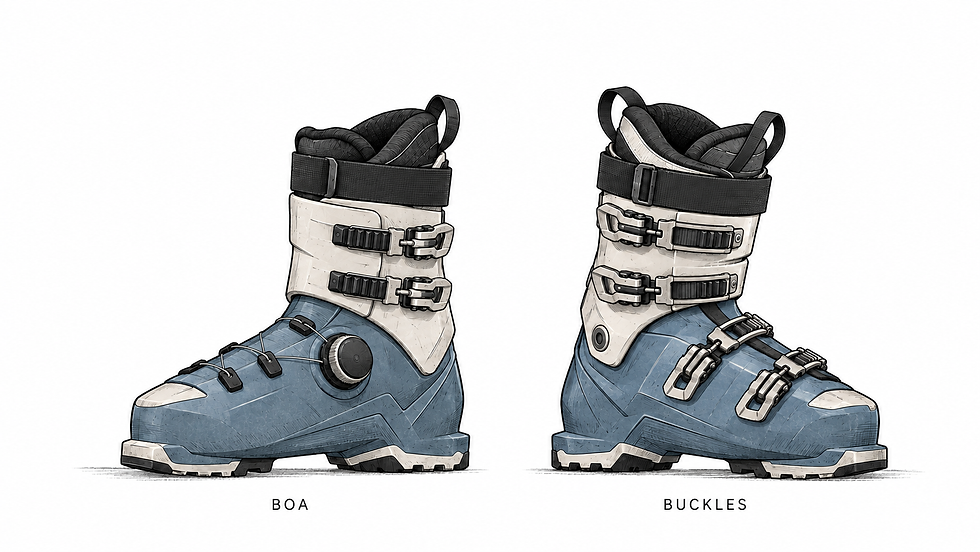
BOA ski boots use a dial and cable to adjust the boot closure in small increments. They can be worth trying if you want easier fit adjustments or a different feel across the top of your foot. Choose the boot that fits your foot and skiing needs; the closure system is one part of that decision.
When I first wrote about ski boot innovation, discomfort was one of my biggest questions. How could equipment designed for such a fun sport be so unpleasant to wear? BOA is interesting because it changes how the shell closes around the foot, a boot design detail that's easy to overlook when shopping by brand or flex rating.
If you are comparing BOA ski boots vs buckles before the season, here is what the technology changes and how to decide whether it matters for you.
How BOA ski boots work
The BOA Fit System combines a geared dial, a strong lace or cable, and guides that route it across the boot. On an alpine boot, the system works with the shell to create a wrap around the foot. BOA describes its H+i1 platform as allowing small adjustments in both directions, so you can tighten or ease the fit without fully opening the boot.
The dial winds the cable mechanically. There is no app or battery involved in that adjustment. The boot still relies on its shell, liner, and cuff to support the skier.
For the alpine system described in Salomon's guide, the basic operation is:
Push the dial in to engage it.
Turn clockwise to tighten, or counterclockwise to loosen in small steps.
Pull the dial out for a quick release. Follow the instructions for your specific boot and dial.
BOA vs buckles at a glance
What changes | BOA closure | Traditional buckles |
Adjustment | Small dial adjustments in either direction on the alpine system discussed here. | Separate levers and catches; many buckles also offer micro-adjustment. |
Tension control | A cable connects several guide points within its closure zone. | Individual buckles let you adjust their sections separately. |
Upper cuff | May retain buckles or use a second dial, depending on the model. | Usually closes with buckles and a power strap. |
Repair | Requires parts matched to the dial and cable system. | Requires parts matched to the buckle and boot model. |
Closure details vary by model. Tecnica, for example, lists micro-adjustable cuff buckles on several boots with lower-shell BOA closures.
Single BOA vs dual BOA ski boots
A lower-shell BOA boot can keep traditional buckles on the upper cuff. Tecnica's 2026/27 Mach BOA MV 120 is one example: its specifications list a BOA shell closure and two aluminum cuff buckles. You use the dial for the foot area and the buckles for the cuff.
Dual BOA boots use separate dials for the shell and cuff. Atomic's Hawx Ultra 100 Dual BOA, for example, has dial adjustments in both areas. This gives you control over two distinct closure zones. It is worth trying both layouts to see which adjustment routine you prefer.
Those models illustrate the layouts. A closure label alone does not tell you which boot will suit your foot.
What BOA can improve
BOA's main appeal is the combination of small adjustments and the way the cable guides distribute tension. Salomon describes its BOA shell design as wrapping the foot more uniformly to reduce pressure points. The shell and cable routing are designed together, so the result depends on the whole boot.
That gives you something useful to assess in the shop: can you secure your foot with a comfortable amount of tension, and can you make a small correction without upsetting the rest of the fit? A dial may make those adjustments more convenient. Buckles remain a useful option if you prefer adjusting individual sections separately.
What the research actually shows
A 2023 study in Frontiers in Sports and Active Living analyzed 21 skiers using versions of a Salomon boot with different lower-shell closures. Participants rated fit, confidence, and carving higher with BOA. Researchers also found differences in pressure distribution and some force measurements. Speeds and ski edge angles did not significantly differ.
The funding and scope matter: BOA funded the study, and all authors were BOA employees. The comparison used one boot platform, including a version retrofitted with buckles. It offers evidence for the wrapping concept under those test conditions. It does not establish that every BOA boot will outperform every buckle boot, or that changing closures will make you faster.
How to compare the fit before buying
Start with a boot fitter who can measure your feet and explain which models suit them. Salomon's boot-fitting guidance recommends trying different pairs and being clear about your ability, where you ski, and the experience you want. Bring that information into the comparison before choosing a closure system.
Use this fitting checklist to make the BOA-versus-buckles decision more useful:
Wear the same ski socks for each try-on. A change in sock thickness makes the comparison harder.
Try both boots on both feet. Ask the fitter to assess shell size and shape, not just the number on the box.
Flex forward and pay attention to heel movement and pressure across the top of the foot. Describe exactly where the fit feels secure or uncomfortable.
Practice a small tightening adjustment, a small loosening adjustment, and a full release. Decide whether you like using the closure.
Compare the complete purchase, including any fitting work. Ask what follow-up adjustments and model-specific repairs the shop provides.
Note* An oversized boot can still leave the foot moving inside it, while the wrong shell shape can create pressure. A fitter should assess those issues before you try to solve them by tightening harder.
Are BOA ski boots worth the upgrade
BOA belongs on your shortlist if you are already shopping for boots and find that its adjustments help you achieve a secure, comfortable fit. If two suitable boots feel similarly good, your preference for the dial or buckles can help decide between them.
If your current boots fit well, I would keep skiing them. When replacing boots, I would prioritize a suitable shell, liner, and fitting service, then compare closures. That is the test I would use for this innovation: does it improve the experience of wearing and adjusting the boot you actually need?
What happens if a BOA dial or cable breaks
BOA provides a repair-kit process for identifying replacement parts. Its Lifetime Guarantee covers dials and laces for the life of the product; it excludes sewn-in or heat-welded guides and housings, and wear or damage to the rest of the product. The guarantee is therefore different from a warranty on the entire ski boot.
Ask the shop which parts fit your model and how repairs are handled. Repair support is useful to understand for either closure system before a ski trip.
Common questions about BOA ski boots
Are BOA ski boots better than buckles
They may suit your preferred adjustment routine and fit, but the comparison depends on the whole boot. Try suitable models with both closure systems rather than choosing from the dial alone.
Do all BOA boots replace every buckle
No. Some alpine boots use BOA on the lower shell and buckles on the cuff. Dual BOA designs use dials on both the shell and cuff.
Can beginners use BOA ski boots
A BOA closure does not determine the required skill level. Choose a boot with the fit and support appropriate for you, and learn its adjustment and release procedure with the shop.
Can BOA fix a poorly fitting ski boot
A closure adjustment changes tension. Shell size and shape, liner fit, and foot support still need to suit the skier. Have a boot fitter assess a fit problem before choosing a replacement.
Does BOA make ski boots warmer
The closure does not supply heat. The 2023 comparison did not measure thermal comfort, so its results should not be used to promise warmer feet.
Have you tried BOA ski boots? I would be interested to hear whether you noticed a difference in fit, adjustment, or how often you loosened your boots during the day.
For more on the ideas behind modern boots, read the evolution of ski boots and how the BTF Ski System works.


Comments